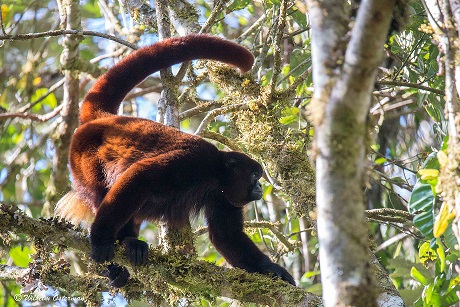
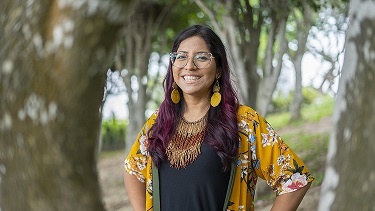
Fanny M. Cornejo is a Peruvian biologist and conservationist. She is the founder and Executive Director of the Yunkawasi Civil Association. She is a leading authority on the study of primates and, in particular, the yellow-tailed woolly monkey. In this interview for the 3Love Inc. blog, we talk about her passion for biology and primates, as well as her work in support of nature conservation and endangered species—efforts that have earned her various international recognitions, such as the Emerging Conservationist Award.
You’re a biologist by profession. What motivated you to pursue this career path?
Thank you very much for your interest and for giving me the opportunity to share what we’ve been working on. Actually, it was a combination of factors that motivated me to study biology. On the one hand, it was the constant curiosity I had—and still have—about the natural world, even back when I was traveling with my parents on the roads of Peru and seeing the diversity of ecosystems. All of that sparked so many questions for me. My parents are geological engineers, and they were very interested in learning more about the natural world; they would send me off to read encyclopedias. So, I was always on the lookout for new discoveries, because that was during the 1990s, when I was growing up, and there was still no internet or easy access to information. I was in high school during those years, and all the research on human genetics was just starting to come out. That was the first time the human genome was sequenced. And it got into my head—I must have seen it on a TV show or read about it somewhere—that I wanted to be a genetic engineer. It turned out that Peru didn’t offer that degree program, but I discovered that people who work in genetics can be doctors or biologists. What I’d always known for sure was that I wanted to study at the University of San Marcos, so the question was which major to choose: medicine or biology. My dad took me to the schools of Human Medicine, Veterinary Medicine, and Biology to ask questions and see what was going on. It was very interesting. I left the morgue at the School of Human Medicine traumatized. The same went for Veterinary Medicine—it was very shocking to see the animals they had there in the labs. I also saw that these are very noble and service-oriented fields, but my interests leaned more toward asking questions and answering them through research. So, I remember that when I went to the Biology Department, there were students with small fish tanks containing different insects and little plants. And they told me they were studying how these tiny flies reproduced. So, I thought it was fun—a field of study where you ask questions and then design your own way to answer them. That’s when I said, “This is what I want to study.”
You’ve devoted much of your career to studying and advocating for the conservation of the yellow-tailed woolly monkey. How did your love for this species begin?
After I decided to study biology, my parents encouraged me to volunteer in different places. So, even before I started my first day of classes at San Marcos, I was already signed up and accepted as a volunteer at the zoo Parque de las Leyendas, so I could learn what biologists do there. A lot happened there. First, I was assigned to care for a baby monkey named Fica, a red howler monkey, and that sparked a thousand questions in my mind: Why do we have a baby monkey? What happened to her mom? All of that sparked my interest in the issue of wildlife trafficking—something I didn’t even know was a problem back then; I was just a 16-year-old teenager. Back then, the internet already existed, so we could look things up, but there was almost no information available. Everything that existed about howler monkeys were studies conducted in Central America or other parts of the continent, but there were almost no studies in Peru. That raised a lot of questions for me—why isn’t anyone doing anything for the monkeys in Peru? And suddenly, I realized that this was something I could study. Later, when I was taking classes at the university—since I was so addicted to reading and researching—I came across a book that, at the time, was the only one available, titled “Primates of Peru”, by Professors Rolando Aquino and Filomeno Encarnación, both professors at San Marcos. That book contains a wealth of information about Peru’s primates; at the time, it was believed there were 32 species, but we now know there are nearly 50 species of primates in our country. We’re the fifth country in the world with the greatest diversity of primates. So, I found this book and suddenly came across a monkey I’d never heard of before—the yellow-tailed woolly monkey. And in that book, there was a five-line section dedicated to the species. It said it was critically endangered, that it was extremely rare, and that it’s found only in the montane forests of Amazonas and San Martín. That struck me as really crazy, because montane forests are in the mountains. When we talk about monkeys, I think almost all of us picture the jungle—flat, green, and hot. But montane forests are in the highlands; this is a high-altitude monkey. It’s a monkey of cold mountains, not of flat, hot terrain. That’s when my curiosity about this almost mythical species began—one that had long been believed extinct and was rediscovered in 1974. Between 1974 and 2000, there was very little information available; there were just a few articles. So, I started dreaming: “This is something I can do—maybe I’ll go to the mountains to look for that monkey.” Later, I had the opportunity to work extensively in the lowland rainforest; as a student, I participated in several projects with the professors who had written the book. And I started working with monkeys, but in the Amazon. I gained a lot of experience there. Then one day, I got a phone call asking if I wanted to conduct a study on the yellow-tailed woolly monkey. I finished my classes, and a week later I went to Pedro Ruiz Gallo, in Amazonas, to conduct one of the first studies of the yellow-tailed woolly monkey. I never imagined it would be so cold or so mountainous—so spectacularly challenging; the forests there are very steep. On top of that, it’s a cloud forest—it’s completely surrounded by clouds all the time. When I saw the yellow-tailed woolly monkey, it was a cinematic moment: there was fog and a little light, and I could see lots of silhouettes of the monkeys moving about, which gave it an air of mystery. I think it wasn’t until several days later that the fog cleared enough for me to see them, because at first all I could make out were silhouettes moving back and forth, but right then and there I fell completely in love with them and wanted to do everything I could for them. In a way, it just happened naturally, and I said, “We have to do something.” So, obviously, I stayed to do something, and it’s been almost 20 years since that moment.
For your conservation work with the yellow-tailed woolly monkey, you received the Emerging Conservationist Award, presented by the Indianapolis Prize. What did this award mean to you?
It was a very strange moment. I didn’t expect to receive recognition so soon. I expected it to happen at some point, but later on—not so soon. So, on the one hand, I felt validated that we’re doing things right. The work I’m currently doing is with the organization Yunkawasi, which my mom and I founded in 2007 with the goal of approaching conservation from within the territory—something everyone talks about now— but back in 2007 when it was founded, talking about working from the ground up with local people in an inclusive, horizontal, and empathetic way—those concepts weren’t as clear then as they are now. In other words, it involves designing a project together—with people from a community and people from Yunkawasi—setting common goals, and ensuring there’s a result. It’s something that might sound logical, but in real life it’s not that common. And the goal is to bring about a change in behavior—because in the world of nature conservation, what we want to achieve, in simple terms, is a change in behavior: we want people to appreciate nature more, and for them to want to invest in protecting forests. It’s a change in behavior, from the person who farms to the person who consumes. So, how do you bring about a change in behavior? It’s incredibly difficult. It’s like the movie “Inception”—how you plant an idea in someone’s mind and get them to make that idea their own. So, that approach my mom and I began using with a farming community, and seeing after nearly 15 years that things were starting to pay off, was incredible. I received this award for my work up to that point and my future potential—that’s why it’s called the Emerging Conservationist Award. I’m very proud of what my team and I have accomplished. That community we started with now has the Oso Dorado Conservation Association, in which both men and women participate, but right now it’s led by women who have gone from being project beneficiaries to becoming partners, working as equals. Now the funding doesn’t go through Yunkawai—it goes directly to them. So now we have rural women who often haven’t had the opportunity to finish their education or be exposed to different experiences, and who are now using a computer, working with Excel, joining Zoom meetings, able to travel to another country to give a presentation and share their story, and coming up with ideas for project proposals. Achieving that is something that makes me incredibly proud. This award and the others that followed recognize that work, and it was wonderful because it gave us hope that we’re doing things right and seeing results. And on top of that, in such an abstract field as nature conservation or indigenous peoples. This keeps us hopeful that we must keep going and that we have no choice but to believe in what we’re doing.
Together with your mother, you founded the NGO Yunkawasi, which works to conserve endangered species. Tell us about the work this organization does.
We focus our work on four main areas. The first is socioeconomic development. It starts with understanding that Peru is a multicultural country—we have nearly 50 different indigenous peoples—and that there are no “empty” forests. The concept of a pristine Amazon untouched by human hands simply doesn’t exist. Peru is full of people everywhere; there are indigenous communities all over the place. One fact I love to share is the domestication of cacao. Eight thousand years ago, Peruvians had the technology and social sophistication necessary to domesticate a fruit that has essentially changed the world: chocolate. Who on this planet doesn’t know chocolate? We are a country with a rich history, identity, and culture. So, based on that, it would be crazy to think that we have to protect nature without considering the people who live in and off of nature. Furthermore, nature’s problems aren’t caused by the people who live there, but by the people who demand resources—people like you and me, who live in cities, people who consume things. So, one of the key elements for discussing conservation—and implementing it in a meaningful and equitable way—is precisely the social and economic development that must take place in those areas. We work with value chains for cocoa, coffee, dairy products, Andean tubers, textiles, handicrafts, and indigenous art.
Our second focus area is governance and territorial conservation. One of the major things we need to do as a country is to organize how we use the land. An example I like to use is to consider where Lima’s water comes from. If you ask anyone where Lima’s water comes from, they’ll tell you it comes from the tap. And where does the tap water come from? From the Atarjea. And where does the Atarjea come from? From the Rímac River. But where does the Rímac River come from? The areas where the water we use comes from aren’t visible to us, and therefore, they aren’t reflected in the amount we pay on our water bill. We don’t pay to protect the source of the Rímac River. We pay to have the water treated at the Atarjea, then piped through a pipe, made safe to drink, and delivered to our homes. But we don’t pay for the production of that water. So, in the minds of a lot of people, that’s not part of our mental framework. I mean, there’s the Rímac River that runs through the city, but there’s no mention of the mountain where the snow-capped peak or the lake is located. And that’s an important part that we have to preserve so that there will be water. So, we can call this concept “territorial management”—how we’re going to organize the territory. If that area produces water, it has to be protected. How is it protected—with what regulations, with what laws? How is it zoned so that it can be protected? So, we work at that level, but in areas with high biodiversity, we help establish protected areas—or, if they already exist, ensure they are managed effectively. Or, when we work with indigenous communities, we help develop land-use planning tools to ensure that the most important areas are protected—for example, areas that provide water or fertile soil—and that productive areas function effectively through an investment plan that guides how we work. And this, of course, must be supported by regulations. So, we work at the public policy level to bring this about. One of the most significant public policies we passed two years ago was the law protecting the yellow-tailed woolly monkey. We worked closely with Congresswoman Ruth Luque; it was a bipartisan initiative co-sponsored by 27 members of Congress. This law provides a framework for addressing land-use planning issues, such as the creation of protected areas, and for encouraging greater public investment in conservation by local governments.
Our third pillar is research and innovation. This involves the collection and recognition of ancestral knowledge. For example, we work with Indecopi to ensure this is recognized and, at the same time, to generate scientific information—not in an extractivist way, but in a way that involves working with local people to strengthen their capacities so that they can collect the data alongside us. We now have a monitoring program for the yellow-tailed woolly monkey, in partnership with rural communities in northern Peru, in Amazonas, where local people collect the data. They already know how to use drones and cameras; they know what data to collect and when during the month to go out. It’s wonderful because this isn’t something they don’t know how to do or don’t understand why they’re doing it—they already get it. In other words, it’s a complex process of behavioral change, and we continue to provide support by serving as a data repository and helping to analyze the data. It’s a gap we hope to close in the coming years so that they, too, can take the lead on these efforts.
Finally, we have the area of education and communications for conservation. On the educational front, we work within the formal education system; that is, we seek to integrate the various initiatives we carry out into the school curriculum. Together with educators from the UGEL, we develop the appropriate tools so that we can then train teachers, who in turn apply them in the classroom. This is how we ensure long-term sustainability. At the non-formal education level, we work with municipal education and citizen science programs led by the Ministry of the Environment. There, we’ve produced several educational videos, and it’s created a wonderful multiplier effect, supported by a management tool. Then, in Communications, the concept is to democratize access to information for everyone and, at the same time, to make conservation mainstream—so that it is not viewed as a niche concern, but rather becomes something important for all of us as a society. For example, we’ve worked on the “Stand up for the yellow-tailed woolly monkey” campaign, and we’ve also carried out various initiatives, such as documentaries produced with local people to tell their stories. We have two documentaries that haven’t been released yet—one about the yellow-tailed woolly monkey and another about a Quechua Huanca community that discovers it’s home to the yellow-tailed woolly monkey. These are stories told by the people themselves using these participatory methodologies. We’re a team of about 30 people, and we’re working in Amazonas, Junín, and Ayacucho. In all the projects we undertake, we strive to ensure that these four pillars are somehow interconnected, that information is documented, that the process is participatory, that the project also seeks to benefit local people, and that it is sustainable in accordance with various regulations that can lend legitimacy and longevity to the initiative. And because of everything I’ve told you, Yunkawasi’s slogan is “Conservation for the People.”
What would you say to children and teenagers who love animals and want to dedicate their lives to fighting for their conservation and care?
I imagine that if there’s a girl or a young person who wants to dedicate their life to conservation, it’s because they’ve already developed a close bond with animals. We live in a world that’s very disconnected from nature. I think a very important part of this is how we can help restore that empathy—that is, by learning to care for a little plant, a small animal, or a little hen that lays eggs—simple, small things that will truly foster that closeness to nature. Growing up in a gray city like Lima, surrounded by walls, disconnects you quite a bit, and it’s hard to reconnect with nature once you’re an adult. If that sense of empathy has already been fostered, that’s fantastic, but a key part of it is fostering that empathy and taking pride in this country—Peru—which boasts such incredible cultural diversity. So, another recommendation would be to get to know it. We live in a country where we can still discover species new to science, a country with countless languages that have yet to be documented. We have a wealth of traditions, customs, and practices that are still unknown. So, I believe that learning about what we have is essential. I also believe that children and young people, in particular, are going to face very difficult times. We’re reaching many serious tipping points with climate change, various levels of pollution, and changes in biodiversity. And perhaps this current generation of young people and children will be the ones who have to face living with a sea devoid of fish—a sea where you can’t swim—or who will have to live with limited access to drinking water. I believe that if that is a future we do not want, those voices are very important, because they will inherit this planet with all its crises. So, I believe that here we need a great deal of determination and grit to be able to choose which battles—small or large—children and young people in particular will have to face in order to ensure they have a decent and just planet on which to live. In this fast-paced world—and especially now that we’re constantly staring at our cell phones without looking up—it’s particularly important to pause for a moment and reflect.