
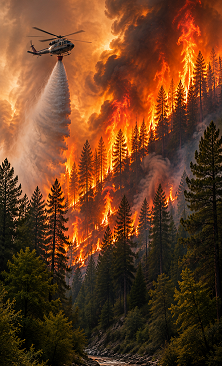
August 18 marks World Forest Fire Prevention Day. The goal is to raise public awareness about the urgent need to care for and preserve all the world’s forests, to redouble precautions, and to do everything possible to prevent forest fires.
The Grim Outlook for Forest Fires in 2026
Forest fires have ravaged nearly six million hectares in North America and Europe in 2026, a toll that once again places these events among the greatest threats to the environment, the economy, and public safety.
In the Americas, Canada accounts for the largest portion of the affected area, with 3.8 million hectares burned and dozens of large fires still out of control. In the United States, fires have destroyed nearly 1.85 million hectares, while in Europe more than 434,000 hectares have already been burned, according to the United Nations Economic Commission for Europe (UNECE).
In light of this situation, the United Nations (UN) has sent a clear message: megafires cannot be contained solely with more firefighting resources. To address the problem, the UN considers it essential to strengthen prevention efforts, improve forest management, and prepare land areas to face a risk that is exacerbated by climate change.
What are the causes of wildfires?
Although images of forests engulfed in flames are often associated with heat waves, the UN points out that human activity remains the primary cause of wildfires. Specifically, nine out of ten fires are caused by humans, whether through negligence or intentional acts. The following are among the causes behind the outbreak of wildfires:
- Negligence during activities in forests and natural areas.
- Agricultural burning or burning of plant debris without adequate safety measures.
- Failure to comply with restrictions during periods of extreme risk.
- Deliberately set fires.
The UN maintains that reducing these behaviors must become a priority for authorities. Proposed measures include awareness campaigns, stricter regulations during high-risk periods, and greater oversight of activities that could cause a fire.
Does climate change affect wildfires?
When asked whether climate change affects wildfires, the UN’s answer is yes, though with an important caveat: climate change does not usually cause wildfires, but it does create conditions that make them more frequent, intense, and difficult to control.
Rising temperatures, prolonged droughts, heat waves, and changes in rainfall patterns extend fire seasons and cause flames to spread more rapidly. As a result, regions that until a few years ago rarely experienced major fires are now facing increasingly severe fire seasons.
Paola Deda, director of the Environment and Forests Division at UNECE, states that every summer confirms an increasingly evident reality: forest fires are no longer an exceptional phenomenon but have become a predictable consequence of global warming. In her view, the best response involves strengthening prevention efforts and moving toward sustainable management of forests and landscapes.
Beyond their environmental impact, fires destroy homes, infrastructure, and farms; force the evacuation of entire communities; and degrade air quality even hundreds of kilometers from the source of the fire.
How can forest fires be prevented?
The UN insists that prevention must become the main pillar of the fight against wildfires. To this end, it proposes a strategy that combines sustainable forest management with new technologies capable of anticipating risks and detecting fires in their early stages. Key recommendations include:
- Manage forests to reduce the accumulation of combustible vegetation.
- Continuously assess fire risk.
- Strengthen surveillance and early-warning systems.
- Enforce temporary restrictions during periods of heightened danger.
- Restore affected areas to rebuild their resilience.
In terms of prevention, technological innovation plays an increasingly important role, as demonstrated by the use of artificial intelligence systems, satellite surveillance, and real-time risk mapping to locate fire hotspots more quickly and facilitate early intervention by emergency services.