
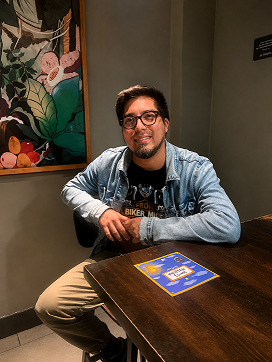
Daniel Maguiña is a Peruvian writer and illustrator who has published several books, including “Anotaciones,” “Mundo T,” “El imaginario viaje de Pollo Fashion,” “Un Fueguito que no quema,” “Fueguito,” and “Sombrita,” among others. In this interview for the 3Love Inc. blog, we spoke with Daniel about his passion for drawing and writing, the value of illustrations in short stories, the importance of promoting reading in childhood, and why a good writer must first be a good reader.
You’re an architect, writer, and illustrator. Tell us how your passions for drawing and writing began.
As a child, I was always drawn to art—drawing, more than anything else. But when you’re a kid, the people around you can’t really tell what might become your passion in the future. I’m currently working in architecture and even earned a master’s degree, but life sometimes throws surprises your way and opens mysterious doors, doesn’t it? In my case, the path to illustration was truly surprising, because I didn’t expect it. When I was studying architecture, I never imagined that 10 or 15 years later I would become a professional illustrator, much less that I would publish children’s books. So, for me, it’s been one surprise after another, including winning awards. Now that I’m 41, you start to recognize those things. And I went down the path of drawing, listening to what resonates inside you—I think that’s always been there since I was a kid, but along the way, you sometimes lose focus. So, I think the journey was about returning to that origin, about rediscovering myself. I was always a restless child, a child who loved art, and I try to hold onto that child I once was when I draw. I think the inner child in artists must always be awake.
What do you consider to be the importance of illustrations in children’s stories?
The illustrator’s job is, above all, to act as a kind of translator of writers’ thoughts and dreams, because ultimately we illustrate things that don’t exist—or exist only in the mind that created them—which, in this case, might be a writer, a screenwriter, or a film director. So, the illustrator plays a very important role because they’re essentially creating things that, in that moment, connect with the other person. That’s a very complex issue—trying to understand that work—because you’re faced with nothingness, with a blank sheet of paper or a computer screen when you’re drawing digitally, and you ask yourself, “So what do I do now?” Then the ideas come, the references, the things you’ve read, and ultimately what you create comes from a place deep inside you where everything you’ve absorbed blends together. Sometimes people say to me, “Hey, you’re a children’s illustrator,” but I say I’m an illustrator. It’s not that I set out to be a children’s illustrator. I never woke up one morning and said, “Today I’m going to be a children’s illustrator.” But I did know I wanted to illustrate. So, lately I’ve specialized in work for children, but it’s not that I consider myself a children’s author. I think I’m a complex author, but I always try to make my work simpler and simpler so that children can understand it.
You’ve published several children’s stories, such as “Fueguito.” Tell us how this story came about.
“Fueguito” had a really interesting journey because the first edition was published by the Metropolitan Municipality of Lima and was distributed for free. Ten thousand copies were printed. So, at that time, they told me, “Daniel, there’s an opportunity for you to publish a book—do you have a book lying around?”. And I had done a project called “Un fueguito que no quema” (A Little Fire That Doesn’t Burn) for a drawing workshop I’d taken, so I had about 10 pages done—the project was already finished—but they asked me to turn those 10 pages into 50. So, I got to work, and within a week I had the book, with 50 pages. It’s a curious thing, because Fueguito was a very minor character in a comic I made; he came from there—it was like recycling—and then this character has become so important. Later, I published the book separately with Colmena, signed a contract with them, we released the edition with my own text, and I was the sole author of “Fueguito.” Then there was the option to make another book, which was “Sombrita.” We finally did it, and the book sold out in six months. Then we released the second edition of “Fueguito” in partnership with Trotamundos, which is the fair I go to in Trujillo. So, I’m very happy with the whole process that “Fueguito” has gone through.
Tell us what the story “Fueguito” is about and what message it has for young readers.
When I wrote it, I didn’t think about messages; I simply created a character who burned everything and then learned to control his power so he wouldn’t burn things again, because at first he’d start by eating a piece of bread and burning it, or picking a flower and burning it. In other words, he did everything wrong and left crying; he went on an introspective journey, found a volcano, and the volcano taught him yoga. So, over time, I’d think about it and talk to my wife, and I’d say to her, “Maybe Fueguito is you,” because she also struggled with anxiety. So, maybe unconsciously, when I created “Fueguito,” I was creating my wife’s character. Or maybe part of me, or who knows—because a character draws from many people. So, when I created that character, I never thought about a message. Even when I write my books, I do without messages or lessons—it’s not that I don’t like them, but it just doesn’t come naturally to me to do something like that. The stories in my head come from having fun—from enjoying what I’m doing, from things that are enjoyable for me, from things I like. When I work on personal projects, the subject has to excite me. In the case of “Fueguito,” I never thought about a message, but when I published it and people talked to me about “Fueguito,” I realized that this character healed wounds and controlled a power he possessed—the power to burn things. He learns to control the fire and no longer burns anything. So, he was more or less like an ordinary person—things happen to you, you keep it together, the problems pass, and then you can rise again. So, there was a powerful message that I hadn’t fully grasped at the time—I mean, I hadn’t thought of it that way— but later, the reaction I got from people who read it—from my readers—was really nice. It was beautiful because they told me about the message, and I’m sometimes a bit of a selfish writer because I don’t really think much about the reader; I think first about the reader that is me and the child I am inside, and then if the book resonates, if people like it and all that, it’s just a consequence. It’s not that I don’t want that, but the book isn’t born with sales in mind, nor is it born with messages in mind.
Book Day was recently celebrated. Why is it important to encourage reading from an early age?
When we’re children, we’re like sponges. But books are objects that are gradually losing their value. So, at home—I have a 12-year-old son—we’ve always encouraged him to read and have built up his own library. I have a system with him where I give him a small reward for reading, and it’s worked because now he picks up books on his own. It’s interesting to see how a child picks up a book not out of obligation, but because they’ve genuinely enjoyed it. I believe that to promote reading, it’s mostly about giving a child a topic they like or letting the child choose as well. Books also catch the eye because of their covers, but it’s the responsibility of the illustrators and authors to ensure the cover relates to the book’s content, because sometimes a pretty cover doesn’t mean a good book. Once a publisher told me: “Daniel, things will change in Peru when people go to the market or the supermarket and buy sugar, salt, meat, chicken, and also pick up a book,” but that will happen when prices go down; a book should cost 10 or 15 soles, not 50, 70, or 80 soles. The price doesn’t match what it should be. In other countries, books are cheaper than here. I think there’s a tax issue that needs to be addressed. The problem here is that books aren’t very accessible, and it’s harder to find books in people’s homes. That’s part of the authors’ job—to help children have greater access to books. Whenever I can, I give away books from my own print run. Children should have more access to books; it’s important. How is a child going to discover a book if it isn’t accessible to them? People ask children to read, but children don’t have the books, so how do they get them? That’s difficult. And I’ve realized that no matter their social status, children are the same. Whether you give a book to a child from a low-income family or a child from a high-income family, it will still catch their attention because it depends on the subject matter. For example, if you give a soccer book to a child from a low-income family or a high-income family, both will enjoy it. I believe that in Peru, little by little, we’re making progress. And it’s very important that more authors join in, that there are more authors publishing.
Every writer is also an avid reader. In your case, what has reading meant to you? How do you feel reading has influenced certain stages of your life?
There is no such thing as a good writer who isn’t also a good reader. I believe that reading is essential, because it gives you the tools to develop your own style and voice. Without reading, my life would be less happy. I discovered books when I was a teenager, when I was already able to discern the themes. When I was on my way to college, I would read all the writers of the Latin American Boom on the bus: Cortázar, Borges, Carpentier—a whole host of Latin American writers whom I still love. I recently visited the graves of Cortázar and Vallejo to pay my respects and took a photo there. So, for me, reading represents something very important. At home, I always have books by my side, and whenever I can, I have a book in my hand. In my studio, I have a bookshelf right next to me, and I’m always looking at the books. Sometimes you buy books you don’t read, but there’s a certain love for books that makes you need to have them close by. At home, I have enough books to keep me reading for another 10 years; I don’t know when I’ll finish reading them all, but more and more books keep coming in. I don’t have any space left, and my problem isn’t a lack of books, but rather where to put the new ones. For me, a book is a very precious object in my life; I always try to surround myself with art, to breathe in those things. I treat books and writers as if they were my friends. My wife teases me because I tell her, “I’m going to see a very close friend.” “Who?” she asks. “Cortázar,” I say. “Come on,” she says and laughs, “he’s already dead and doesn’t even know you.” But that’s how I feel—as if he were my friend. It’s just a reader’s and a fan’s thing.