
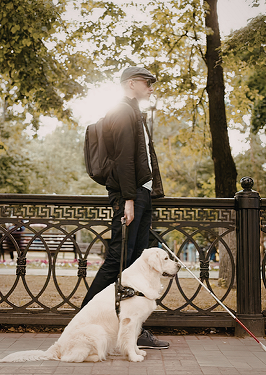
International Guide Dog Day is observed on the last Wednesday of April to highlight the importance of guide dogs in supporting the mobility and independence of people with visual impairments.
How is a guide dog trained?
To support a person with visual impairments, it’s not enough to have a sweet and adorable pet. Special training is required to train dogs as mobility assistants so they can perform their duties effectively.
There are guide dog training schools in various countries around the world, offering specialized training programs.
A guide dog must possess the following characteristics:
- It must be of an ideal size; the Golden Retriever, Labrador Retriever, and German Shepherd breeds are the most suitable for guide dog work.
- It must be sociable with people and other animals.
- It must follow commands or instructions.
- It must be docile, agile, and easily trainable.
Another key recommendation for training a guide dog is to start at an early age (after 4 weeks of age). As part of their training, they learn various skills and abilities:
Puppies:
- Dealing with reactions to sounds, unfamiliar environments, and new experiences.
- Learning to walk on a leash.
- Obeying simple commands.
- Eating and relieving themselves at set times.
By the time they turn one year old:
- Obey commands.
- Learn to walk on the person’s left side, avoiding any obstacles they may encounter along the way.
- Wear their harness, which serves as a means of communication between the guide dog and its owner.
- Learn “intelligent disobedience,” which involves not obeying an owner’s command if it could put them in danger.
- Board public transportation, navigate doors, stairs, and chairs.
- Behave appropriately in public places.
Key Facts About Guide Dogs
Here are some key facts about the work of these noble four-legged friends:
- Guide dogs are also known as seeing-eye dogs or assistance dogs.
- Training a guide dog can take between 2 and 5 years to prepare it to assist a person with a visual impairment.
- It is estimated that the first guide dog school originated in Germany during World War I to help returning war veterans.
- Guide dogs are the only animals legally recognized with the privilege of being allowed on public transportation.
- Public transportation providers must allow a guide dog to occupy a seat or be positioned next to an aisle, depending on the mode of transportation.
- The first breed of dog used for guide dog training was the German Shepherd.
- People with visual impairments who are using a guide dog for the first time must learn to walk again, as they need to move at the same pace as the guide dog.
- Despite their training, guide dogs are unable to distinguish colors such as red and green, for example, at traffic lights.
- If you encounter a guide dog and its owner on the street, it is not advisable to touch the dog, as it could distract the dog from its work.