
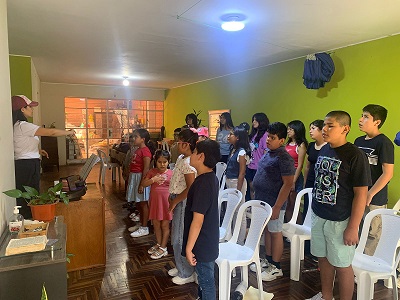
Canto para ver (I sing to see) is an inclusive choir founded two years ago in Lima, Peru, with the goal of promoting diversity and social cohesion through song and music, bringing together both children with visual impairments and sighted children. In this interview for the 3Love Inc. blog, we spoke with Natalia Gutiérrez, the choir’s founder and director, who told us about her motivation for creating the choir, the importance of inclusion, and their current dream of traveling to Colombia to participate in a choral gathering. Additionally, two choir members shared what they enjoy most about the experience of singing alongside their peers.
Interview with Natalia Gutiérrez, director of the Canto para ver choir
It has recently been two years since the Canto para ver choir was founded. What was the main motivation for creating this choir?
Natalia Gutiérrez: The main motivation for creating Canto para ver was to provide a space where children and young people could socialize, so they would have a place where, through music, they could form the bonds that society sometimes prevents us from forming in our daily lives. Each member contributes a little of themselves to this musical family that we’ve been building over the past two years. Part of the reason and also the goal driving this idea is to encourage the children in the choir to learn to get along with one another from a young age, despite the differences that seemingly exist—but not just the children; the families also interact with one another and become more aware. So, Canto para ver is motivated by the desire to be a space for raising awareness, and it’s very beautiful because everything unfolds naturally. I’ve felt that during rehearsals, and then when we’ve had concerts, people leave feeling very moved. So, I think that’s the motivation not only for creating it, but also for the children to experience it. In other words, it’s the daily motivation of seeing how we’re becoming more human again. The routine of life sometimes puts us in a bit of a robotic mode.
Both sighted children and children with visual impairments participate in the choir. How have these two groups integrated through music and choral practice?
Natalia Gutiérrez: The integration has been quite natural. In fact, children have far fewer prejudices than adults. So, I’ve seen that they’ve gotten along very well. I aim for the work to be unified. While it’s true that this year we’re starting to work with sheet music, the entire initial phase of the choir has been about everyone doing what we can all do: if we can all hear, then we all learn by listening; if we can all move our bodies, then we all learn by moving our bodies. We’ve done teamwork exercises. In fact, music is based on the premise that there is no music without silence first. And I try to help them gradually become more aware that there must be silence in order for us to hear one another. If there is no silence, we cannot hear one another. And this integration also arises from that silence—from knowing when I can speak, when I listen, and when I don’t listen. These are activities in which I’ve aimed for us all to always do the same thing: we all listen, and we all speak when we need to speak. So, the integration has been gradual. And it’s also very nice to see how they’ve already taken the initiative on their own; they don’t wait for me to tell them, “Help your classmate”—they just do it. Through activities or routines like recess, entering the classroom, leaving the classroom—through those simple things that happen in any gathering or school—they have learned to get along, to integrate with the classmate who has a disability. They are already interacting and integrating, without me having to tell them, “Integrate.”
We know the kids are planning a trip to participate together in an international event. Could you tell us a little about this event?
Natalia Gutiérrez: This year we’ve been invited to Pasto, Colombia, for a choral festival called the Circuito Coral por Nariño. And on this occasion, we’ll have the chance to interact with other choirs and music teachers. In these first two years that we’ve performed in Lima, this will be the first time we’re traveling abroad to represent Peru because we’re the only Peruvians going, and I think it’s going to be a wonderful experience—a very meaningful one—to know that you’re taking your voice to another country to share experiences, not just musical ones, but also to spend time together. The kids will be together for a week, and I think that’s really special. I experienced this myself as a child when I sang in the National Children’s Choir of Peru, and I know firsthand how beautiful and valuable that is—the confidence it can build, how it can help you. It’s also a great boost to self-esteem, to strengthening bonds, and to reinforcing one’s own virtues. That trip is going to be illuminating.
If any individual or organization would like to support the choir and help make this dream of traveling together to Colombia a reality, how can they help?
Natalia Gutiérrez: Any help we receive is incredibly valuable to us. You can contact us through Canto para ver’s social media accounts—either on Instagram or Facebook—where you’ll find all the information; feel free to leave us a message. Any support for us will be incredibly helpful, whatever form it takes—any donation you can give. It’s important to remember that Canto para ver is an independent choir; it’s a project that doesn’t belong to any association or institution. So, it’s a self-managed choir. We’re currently organizing several activities. We’re holding a raffle and will have a fundraising concert in May. Everything we raise will go toward covering the kids’ travel expenses and per diems so they can have the experience of traveling. The last thing I want is for them to worry about those things; I want them to go and enjoy themselves. Any support is welcome—no matter how small it may seem, every little bit helps.
Interview with two members of the Canto para ver choir
What do you like most about singing with your fellow members of the Canto para ver choir?
Natalia Díaz: What I like most is that we learn new things every day and become more disciplined, all while having a lot of fun with our teacher.
Aissa Menacho: What I like most about singing in the Canto para ver choir is that when we all sing, we’re like one big family. It doesn’t matter if we can see or not, because when we sing, our voices come together and sound really beautiful. I like spending time with my classmates, learning new songs, and feeling that we all support each other.