
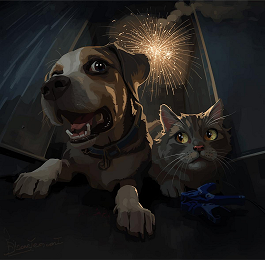
Rockets, explosions, and cascades of colorful fireworks are a characteristic feature of celebrations around the world, whether it’s the Fourth of July in the United States, Christmas, or New Year’s Eve in various countries. But while the bursts of light and sound bring joy to those celebrating, fireworks can cause panic in animals. They also leave behind traces of pollution that take a toll on the environment and people.
Stress and anxiety for animals
The intense sounds and flashes of fireworks frighten animals, both domestic and wild. Fear and stress responses have been documented in animals of all kinds. Wild animals may flee when fireworks begin. In fact, weather radars have recorded groups of birds taking flight, while other studies have shown sea lions and seals fleeing.
This rush to escape drains the animals’ energy and can cause long-term damage, Bill Bateman, professor of ecology at Curtin University in Australia and author of a review of global research on the impact of fireworks on the environment, told The New York Times.
Animals may leave their habitats altogether, or return with less energy available for normal survival. Birds frightened by fireworks may abandon their nests, leaving behind chicks or eggs, exposed to threats such as predators.
Occasionally, fireworks kill large numbers of birds. In Beebe, Arkansas, in 2011 and 2012, thousands of blackbirds died after New Year’s Eve after being frightened by fireworks. In 2022, fireworks in Taylor, Texas, caused nesting egrets to scatter, leading several of them to crash into electrical transformers.
The pollution and litter they leave behind
In the short term, fireworks cause an increase in air pollution and leave behind toxins in waterways and soil that harm people and wildlife in the long term.
“Setting off fireworks produces thick smoke particles that are loaded with many nasty chemicals,” Bateman told the New York Times.
Studies have shown that air quality worsens in the hours after fireworks, as it contains particles, metals, and gases such as sulfur dioxide. Levels are highest after celebrations where fireworks are used heavily over several days. Air pollution exacerbates lung and heart disease and is linked to other health conditions. Chemicals related to fireworks, such as perchlorate, have also been detected in bodies of water.
Fireworks are also often manufactured and wrapped in plastic and leave debris that can be ingested by animals and broken down into microplastics. One study found that New Year’s fireworks in London caused an immediate increase in microplastics.
Fireworks also pose a risk of causing fires, which can result in the death of people or animals.
Ways to reduce damage when celebrating with fireworks
Around the world, different approaches have been adopted to reduce risks to people and wildlife while continuing to celebrate with fireworks, such as:
- Preventing fireworks from being set off in sensitive areas or banning them altogether.
- Restricting fireworks for personal or individual use.
- Promoting fireworks with fewer chemicals.
- Organizing alternative displays, such as drone light shows.
With traditional fireworks, damage can be reduced by shortening the duration of shows and the number of fireworks used, and by setting them off away from people and animals. Experts said community displays, set off in the air, are better than setting off fireworks individually.
Drone light shows are becoming increasingly popular. They are quieter and do not release the intense bursts of pollution associated with fireworks, although they still carry some minor risks. In recent years, several cities and venues have switched from fireworks to drones, citing concerns about wildfires, pollution, and wildlife.
When trying to reduce the damage caused by fireworks and other environmentally damaging practices, “you’re not going to make friends by saying, ‘What you like is bad; stop doing it,’” Bateman said. “You have to look first for options that are more sustainable, but still don’t take away the pleasure of having these things.”