
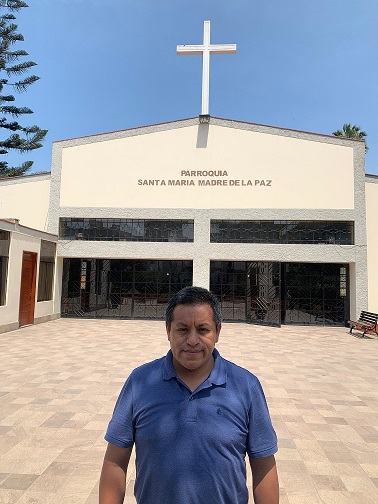
Father Pablo Gonzáles has been at the helm of the Santa María Madre de la Paz Parish in Lima, Peru, for five years. In this interview for 3Love Inc., we talk with Father about the importance of social media in evangelization, the main teachings of Pope Leo XIV, and his advice for young people to maintain hope and faith in the current climate.
You have been a priest for 18 years. How did you discover your vocation?
It’s simple. It was a religious experience.
You have been parish priest at Santa María Madre de la Paz for five years. What kind of activities does this parish carry out to help others?
We carry out religious activities such as spiritual accompaniment, spiritual direction, spiritual counseling, guidance for couples and families, and assistance for the most vulnerable: children, adults, the elderly, the sick, and anyone else who is vulnerable.
What projects or works that you have not yet been able to carry out in the community would you like to do?
Many projects and many things can be done. For example, creating a center for the elderly. You know that there are only centers for children; parents go to work and leave their children in daycare, but there are no centers for the elderly. This population is increasingly vulnerable because they are advanced in age, they are retired, their children leave, they leave their parents behind, and they are left “orphaned,” without the presence of those who should be by their side. So, care at that level is important, giving a good quality of life to the elderly, who have taught us so much. That is why Pope Francis said: “Learn from your elders, from their experience and patience, so as not to make the same mistakes in the future.”
The parish has accounts on Instagram and Facebook. Why is it important today for a religious institution to have a presence on social media?
If you have listened carefully to John Paul II’s The Way of the Church, the Pope has taught us how we must manage evangelization through the media, learn to use the internet, so that humanity can be more in sync with the Church and vice versa. Therefore, we must make good use of all media that help bring human beings closer to God. Social media and the media are there for that purpose, to bring people closer. Visual language says many things, sometimes much more than words. A gesture captured in a photograph or image is the best teaching that remains in our memory. The first teaching is visual. Words come and go, but memory is fragile. On the other hand, images and iconography remain etched in our memory and our hearts. So, the evangelization of recent times circulates in this way. We need only remember, for example, the new missionary we have, Carlo Acutis, with social media, which is also the presence of the Church in the world.
Since last year, we have a new Pope, Leo XIV. What do you consider to be the main lessons or examples of life that he gives us?
Within the teachings of Pope Leo XIV, there are many things that can be valued and that are relevant today. For example, February 11 was World Day of Prayer under the illumination of the parable of the Good Samaritan, that is, what is the Church seeking? Closeness to human beings. God has become close to human beings, he became incarnate, he became man, he walked like us and lived like us, he had the experience of an ordinary person, but without sin. So, look at the Pope’s doctrine: the Church needs that closeness, so that human beings do not feel distant from God. God is not in heaven, he is here, and Jesus says it clearly: “I am among you.” We just need to recognize him. And recognition comes precisely from gestures, from words, from the simplicity of life. Pope Leo XIV rightly conveys this, because despite being a person of a different background to ours, living here in Peru he cultivated that closeness, he experienced the closeness of the people’s faith. That is what the Pope also tries to convey in all his audiences, in everything he does. But unfortunately, as he is a public figure, he has to maintain certain protocols, and that definitely limits any human being in everything they want to do. For example, we are on the plain of life, we can sit here or there and share and experience work or be closer to the sick, the needy, the vulnerable, it is easier, but when you enter a more formal environment, it becomes a little more complicated, but there is the Pope’s message: closeness must not be lost.
In a time of great social change and difficult situations around the world, what advice would you give young people to help them maintain hope and faith?
St. Paul said it best: “Everything can happen, as Jesus says, but love remains.” That is hope. Let us never lose hope, because people, not only God, but also our parents, teach us to love and teach us to do the right thing. God does all things well, and we have hope that, despite living in an environment that may be a little disinterested, cold, and indolent, where many hearts seek only power and money, we are still the rest of humanity. The Catholic Church always has the hope that together we are all people, we are human beings, we are children of God, and therefore we learn to share bread, we learn to share what God gives us, we learn to be in solidarity. That is hope: that the world will be in solidarity. In other words, it is not just a matter of lining one’s pockets, as many people do, but of having a generous heart. That is Jesus’ message: “Keep nothing for yourself, learn to give, because in giving you receive more.” So, every time you are more generous, God also gives you more, and that is hope: that young people learn to be generous, that they learn to have hope that with them it is possible to build Jesus’ dream, a new society where no one suffers indifference, meanness, selfishness, or isolation. We are all important in God’s eyes, and maintaining that hope of valuing human beings is the greatest gesture one can make. That is why Jesus teaches us to love one another; that is the greatest hope, that we learn to love one another and to live in that love. I will conclude with this little reflection: “He who loves does no harm.” I have hope that if you learn to love, you will do no harm at all, neither in thought, nor in gesture, nor in attitude, much less enter into a hostile environment. I hope that we can live in an atmosphere of peace, which is why this parish is called Santa María Madre de la Paz (Saint Mary Mother of Peace). So let us keep this in our hearts, and let it be non-negotiable with anything, not with power, not with money, not with anything. Maintaining hope and maintaining peace are characteristic of the wealth of those who have their hearts set on God.