
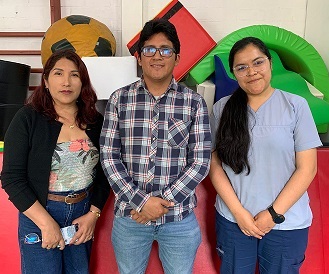
The C.E.B.E. (Center for Special Basic Education) “Beato Edmundo Rice” is located in the district of Chorrillos in Lima, Peru, and has a population of approximately 150 students who have different types of disabilities or conditions such as Autism Spectrum Disorder (ASD). In this interview for the 3Love Inc. blog, we spoke with Gloria Cáceres, occupational therapist; Kathya Bravo, physical therapist; and Giancarlo Chávez, physical therapist, who discussed the importance of therapy in children’s development, the main challenges they face, and the personal rewards they gain from working with children with disabilities.
What types of therapy do students at C.E.B.E. “Beato Edmundo Rice” receive?
Gloria: This is the only C.E.B.E. in Chorrillos. This institution is home to approximately 150 to 160 students from the area and surrounding areas. Most of them are from low-income families. There are children whose parents, due to factors such as work or lack of time, do not take them to their therapy sessions. In other cases, it may also be because the parents have not fully accepted or are not aware of the diagnosis. We assume this because there are parents who are sometimes difficult to talk to, and you begin to realize their personality. It would be ideal for the institution to have a well-equipped environment. The C.E.B.E.s do not provide therapy like that given in a private center or health institution, but with the right infrastructure, it could be done. We currently have 14 classrooms, where we offer occupational therapy, speech therapy, and physical therapy. This year, the interdisciplinary team has been strengthened. So, with a well-equipped environment, we can do a better and much more comprehensive job. The largest population is children with autism, so there is sensory or behavioral treatment to regulate that. We see some classrooms where the children, due to fatigue or the time of year, have less tolerance for completing their class hours. At recess, they throw themselves on the floor, cry over anything, or come in irritated. But if we had good therapy materials all year round, we could improve that. We could even raise awareness among parents to do fundraising activities to complement what we are lacking.
Why is it important to carry out this type of therapy in terms of student learning and improvement indicators?
Giancarlo: Here, students attend a public educational institution. They come to learn, but we know that comprehensive development does not only come through teaching, but also through physical, movement, and sensory experiences. And that’s where we come in as therapists. Through a specially equipped environment, we try to provide our intervention. For example, the occupational therapist looks at the sensory systems, while we as physical therapists look at physicality and expression. This will help students to a certain extent to improve their areas of development and also to participate socially, because often when we intervene, they only remain in this environment or context, but what we want is for the children to be able to participate socially, for example, within their families or communities, so that they can exercise their voice and all the skills they have developed. So, I think therapy is important because it is fundamental to their development.
How does a well-equipped multisensory classroom contribute to the development of students with disabilities?
Gloria: Everyone is sensory. As we grow up, we learn through our senses. We used to be taught about the five senses, but now we talk about up to eight senses. So, when a child is born, they receive information from their environment, process that information, and respond in an adaptive way. However, we see that these children, due to different diagnoses or conditions, have difficulties or delays in adaptive motor, language, and social learning skills. But a properly equipped environment can help open these channels. It’s as if they had a veil over their eyes and you open their eyes, awakening their senses to learning. For example, we see a child with a lot of motor restlessness, a sensory seeker, who runs around and doesn’t know what to do, is unable to sit still. In this case, vestibular equipment that involves movement can help. Vestibular equipment includes suspended equipment, such as hammocks, and there are different types of equipment that work different muscle groups. Vestibular equipment works on motor planning, body organization, and helping the child make more eye contact. In the multisensory classroom, the physical therapist works, the speech therapist works, and each one uses tools to achieve their goal. The physical therapist will work on everyday life and motor development, I will work on the sensory aspect, and the speech therapist will work on stimulating language. So, it all adds up.
Why is it important for you to have the help of organizations outside the C.E.B.E. in order to implement improvements in the infrastructure of the school?
Gloria: The majority of the student population here has ASD (Autism Spectrum Disorder). Some cases are moderate to multi-disabled, but if it were a child with a level 1 disability, they would have a better chance of getting ahead. With a good environment, we could think about achieving their autonomy. And the first point of inclusion is in household activities, from which we develop those skills. Here we do small trials, for example, cooking and food preparation. In other words, everything that 3Love is donating to the kitchen will enrich their experience, so that later, outside the institution, they can create a pastry or chocolate business with their families, they can start their own small businesses, and the children can feel useful, because we must keep in mind that when they leave the C.E.B.E., few young students will be able to be independent. It would be very enriching to have that external support, because we have a foundation for the initial level. So, by working on this, we are projecting that when they move on to primary school, there will be better results, and when they move on to T.V.A. (Transition to Adult Life), there will be better results. Then we could say that there is a better quality of life, which is what we are looking for.
Kathya: That way they could achieve independence.
Giancarlo: Private institutions are essential because, to a certain extent, they allow us to provide a higher quality education service. As an interdisciplinary team, we have a deep understanding of students’ needs. However, not having adequate infrastructure or equipment limits us somewhat. But we do everything we can to ensure that students can develop everything they need from our intervention. With the help of 3Love, I know it will be transformative for our institution. Many students go to hospitals or other places to ask for therapy because they don’t have the financial resources to go to a private institution. However, hospitals no longer have the space or capacity to treat them. Even if they do receive treatment, they are given a package of six sessions, but then there is a three- or four-month wait before they can get another package of six sessions. So, having a suitable environment will greatly help students to develop and achieve autonomy.
What is the most important lesson you have learned from working with children with disabilities?
Kathya: I used to work in a hospital, and working at a C.E.B.E. has completely opened my eyes, as I have become a little more humane when dealing with children who are autistic or have cerebral palsy. When you work with them, you also give a little more of yourself and demonstrate skills that you might not be able to show elsewhere. Here, you see the most creative ways to use the resources we have and share them with all of them.
Gloria: Speaking as a mother, I had an experience with my eldest son, who had some difficulties. Thank God, over the years he has been able to overcome them and is now living a normal life. So, working in a special school has led me to thank God for the children I have and has led me to be more empathetic with parents, to put myself in their shoes. It’s very important to learn to put yourself in the parents’ shoes, to have a little more patience. They are special children of even more special parents, with high expectations. Many times, you have to be their support and lift them up, because sometimes they go to places where suddenly there are professionals who have lost that sweetness, that empathy, that delicacy in saying things. Because it’s not about lying, but there are ways and ways to express the children’s situation. And sometimes that gets lost. I think we shouldn’t lose that human touch, trying to help out however we can. Here, with the little we have, we try to get by, or we look for solutions using our creativity. Necessity is the mother of invention. Here we become inventors and creators. That’s where human creativity lies. And that stems from the need to help, the love for the profession, the desire to work here, because no one forces us to apply, we do it because it comes naturally to us. But if people like you support us, our work definitely becomes richer, and I think that all of us are here because of that desire to help.
Giancarlo: I have been working for about six years in different C.E.B.E.s, and for me it has been a very significant change on a personal level. Working with children with disabilities or conditions such as autism has, in a way, helped me to value the essentials more, to develop that authentic patience that one must have on a daily basis when working with the entire student population. It has also taught me to celebrate those small achievements or big victories that we see every day, because children often progress at their own pace. Each student develops, achieves, and accomplishes certain things in their own time. So, I believe that working at a C.E.B.E. gives you an opportunity to be more human and more empathetic towards everyone, to develop the skills that the world needs in these times.